Your cart is empty
You may check out all the available products and buy some in the shop
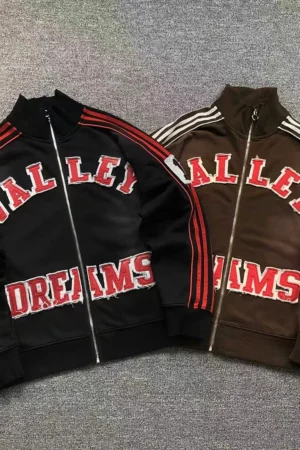
Return to shopVALLEY jackets are the outer layer that ties an outfit together. A zip-through track jacket in the same visual language as the rest of the archive, it lets a full-print top and printed bottoms sit under one unified surface instead of competing for attention.
Both colourways carry the Valley Dreams motif — one in brown, yellow and black, one in black and brown — printed across the chest and sleeves, so the jacket reads as a deliberate layer rather than a plain zip-up.
The cut is oversized to layer cleanly over the rest of the range. Take your normal size for the intended dropped-shoulder fit; if you plan to wear it over a hoodie, compare the chest and sleeve measurements to make sure it still closes comfortably.
Wear it over a VALLEY hoodie or a VALLEY poster tee, complete the set with VALLEY trousers or tracksuit bottoms, and in summer wear it over a tee and VALLEY shorts. See the VALLEY archive for the rest of the range.

A full-bleed top and a printed bottom can fight each other. A jacket solves that by giving the outfit one calm outer surface: worn open, it frames what is underneath; worn closed, it becomes the graphic statement itself. Either way it is the piece that decides whether the fit reads as considered or as noise.
It works both ways. On its own it is a light outer layer with the Valley Dreams graphic doing the work; zipped over a print, it is the piece that unifies what is underneath. If you want one jacket that covers both, this is the most flexible in the range.
Keep the two prints at different scales. A large all-over top under a jacket with a smaller chest-and-sleeve graphic reads as one look; two loud full-bleed prints at the same scale fight each other. Worn open, the inner graphic becomes the focal point and the jacket frames it.
Yes — it is built for the in-between seasons. On its own it covers cool mornings and evenings; over a hoodie it adds a wind-resistant outer layer without the bulk of a heavy coat. For deeper winter, wear it as a mid-layer under a larger jacket.